Dong Du Reading Club
Japan is entering autumn — the season when nature changes its colors, when leaves dress themselves in every shade, and when poets and writers find inspiration in nature and love. It’s a season of cultural and sporting events. After the heat of summer, the cooler, gentler weather makes it easier for people to read more, and for longer.
The Japanese have a custom of encouraging one another to read in autumn, especially during “Reading Week” (読書の週間), held each year from October 27 to November 9. This year (2021) marks the 75th year since the Reading Week movement was launched (see the website of the Reading Promotion Council 読書推進運動協議会 http://www.dokusyo.or.jp/jigyo/jigyo.htm).
We’d like to take this occasion to share with our compatriots in Japan some thoughts on the Japanese love of reading, the connection between reading and a country’s social and economic development, why we Vietnamese should read more, and finally, the daily reading initiative of the Dong Du Japanese-Language School and the launch of the Vietnamese Association in Japan’s newsletter.
WHY THE JAPANESE LOVE TO READ
Japan is famously known as “a country of book-readers” (本を読む国民の国). A few numbers illustrate the Japanese appetite for books and newspapers: Japan publishes around 70,000 new book titles every year — including roughly 15,000 in social sciences, 12,000 in arts and life, 13,000 in literature, and 5,000 in natural sciences (Statistics Bureau, Ministry of Internal Affairs and Communications, https://www.stat.go.jp/data/nihon/26.html). Around 2,800 magazine titles/series are published each year; more than 13,000 libraries nationwide hold over 14 million volumes and documents; and over 42,000,000 newspapers are distributed daily. And more.
The Vietnamese reading website Trạm Đọc has a thoughtful analysis of why the Japanese have such a passion for books and newspapers (Dr. Nguyễn Xuân Xanh, March 2012, http://tramdoc.vn/…/tai-sao-nguoi-nhat-me-doc-sach…). A few excerpts:
– In fact, the Japanese have a long, formidable reading tradition reaching back at least to the Tokugawa era (1600–1868). In the early days of Tokugawa Ieyasu — who unified the country and founded the longest peaceful regime in Japanese history (265 years) — a samurai who could express his ideas clearly on paper was a rare exception, and illiteracy was the norm. Pre-1600 Japanese culture was a samurai culture. But by the late 18th century, an illiterate samurai had become a sad embarrassment, and by the mid-19th century the situation had reversed entirely.
– Before 1600, learning in Japan was the monopoly of the aristocracy and clergy, but in the Tokugawa era it became the work of the entire country. In 1615, after pacifying nearly three hundred fiefdoms (han 藩), Shōgun Tokugawa Ieyasu established what was effectively a federal political system and issued a “big-bang” order to the daimyō (大名), the lords of the fiefdoms, and to the samurai. Article 1 read: “bun (文) in the left hand, bu (武) in the right.”
– “Bun” means letters, learning, the brush; “bu” means martial arts, the art of war — from which the word bushi (samurai) and bushidō (way of the samurai) derive. So Article 1 says: “book in the left hand, sword in the right” — and letters come before arms, in order to govern the country for the long term. The Japanese samurai gradually became a learned ruling class. In Japan, governing was the hereditary work of the samurai class, not of Confucian scholars as in China, Vietnam, or Korea. Confucian scholars at most served as low-paid advisors. Japan also had the “shi-nō-kō-shō” (士農工商, scholar-farmer-artisan-merchant) hierarchy under Chinese Confucian influence, but here “shi” meant warrior, not scholar.
– The daimyō now had to learn culture, the various sciences, and the arts of administration. A learned daimyō had to read every day. To support the studies of daimyō and their retainers, libraries were built, books were collected on a grand scale, and books became symbols of knowledge. These libraries held works on Japanese and Chinese history, on Confucianism, Buddhism, and Shinto; on military arts and strategy, geography, astronomy, economics, mathematics, medicine, and countless classics of literature. Shōgun Ieyasu himself founded a library. Every period of Japanese history had its famous libraries, but during the Tokugawa era Japan had more libraries than ever before.
– The Genroku era (元禄, 1688–1704) — the golden age of Tokugawa with stable economy and flourishing arts and literature — saw a surprisingly modern publishing system in Japan, marked by major publishers, well-known illustrators, and famous authors. Books were often printed in runs of more than 10,000 copies! That was a “huge” number for the time; Japan then had only about 20 million people (around 30 million by the Meiji era). In 1692 Japan already had multi-volume catalogs of printed books for public use. (Vietnam still has nothing comparable in its bookshops today.) …
– We Vietnamese should learn from the Japanese unique reading culture and curiosity, and learn in order to create for our country. Studying merely to earn a living is precious for the individual and family, but it tends to breed a self-satisfaction that makes people stop reading once their goal is reached. With that mindset, Vietnam will have individuals but no nation.
– Only by reading in the Japanese spirit — wanting to know what the world is thinking and doing, in order to absorb the world’s best and create something new to enrich Vietnam — will we keep reading endlessly, devouring the boundless world of knowledge. Only on that foundation can a reading culture truly flourish. Not just a few thousand, but millions of fine books will then be eagerly received by readers. Only on that foundation will the people quickly grow prosperous, the nation strong, and the homeland enduring.
READING: THE STARTING POINT FOR ENLIGHTENING THE PEOPLE, STRENGTHENING THEIR SPIRIT, IMPROVING THEIR LIVELIHOOD
Japan can be said to be the first East Asian country to have absorbed Western civilization, science, and modern technology in order to renew the country and develop economically and socially.
Samurai who were skilled with the sword and equally skilled with the brush also recognized early on that the Tokugawa shogunate could not stand up to the Western powers, and that maintaining feudal fragmentation while keeping the country closed off from the outside would mean inevitable conquest by the Western powers. So in 1853, after being shaken by the cannon-fire of Commodore Matthew C. Perry’s iron-clad steam-powered black ships at the port of Uraga, the samurai of Satsuma (薩摩藩) and Chōshū (長州藩) set aside their long-standing hostility to ally and overthrow the shogunate, establish a centralized monarchy, and push forward the renewal of the country. The first year of the Meiji era (1868) was also the year of the decisive Boshin War (戊辰戦争), which ended the more-than-260-year Tokugawa shogunate.
The Japanese curiosity, love of inquiry, love of research, love of reading, and constant self-improvement drove the Civilization and Enlightenment movement (Bunmei Kaika 文明開化), and provided the foundation for Japan’s economic and social development from the Meiji era onward (1868~). (Note: Bunmei Kaika 文明開化, together with Fukoku Kyōhei 富国強兵 — “rich country, strong army” — and Shokusan Kōgyō 殖産興業 — “promote industry” — were the three main slogans/objectives of the Meiji Restoration.)
Meanwhile, in Vietnam? — After defeating the Tây Sơn dynasty in 1802, Nguyễn Ánh ascended the throne as Emperor Gia Long and founded the Nguyễn dynasty. Although the Nguyễn emperors did introduce some educational reforms and adjusted the way talent was selected through the regional, court, and palace examinations, the content remained chiefly literary memorization, Confucian classics, and recitation of poetry — not “practical learning” grounded in empirical science to expand knowledge, master the principles governing the universe and the workings of society — which is what nation-building requires.
In the early 19th century, Vietnam, like Japan, China, Thailand, and others, was under pressure from Western powers to open ports for trade, allow missionaries to preach, and so on. But while the Tokugawa-era samurai of Japan held a book in the left hand and a sword in the right and recognized the need for “practical learning” to renew the country, the Nguyễn emperors and mandarins remained convinced that China was strong and Westerners were barbarians; when they discussed worldly or national affairs, they took Chinese precedents as the standard. The earnest petitions and reports of Nguyễn Trường Tộ to Emperor Tự Đức from 1861 to 1871 — proposing reforms in administration, education, and military affairs — were ignored by the Huế court. Commodore Perry’s cannon-fire at Uraga in 1853 awakened the Tokugawa samurai; General Genouilly’s cannon-fire at Đà Nẵng in 1847 was not enough to wake the court of Emperor Thiệu Trị.
For lack of statesmen with vision and breadth, the Nguyễn dynasty squandered the chance to renew the country, becoming bogged down in suppressing rebellions and ultimately easy prey for French colonialism and imperialism. So in the mid-19th century, while Japan transformed itself into a great Eastern power, Vietnam was made a French colony — and from then on endured a century of independence struggle, then fratricidal civil war, foreign domination, social fragmentation and stagnation that lingers to this day.
Nearly 40 years after Japan formally entered the Meiji Restoration, in 1905, Phan Bội Châu, Tăng Bạt Hổ, and Đặng Tử Kính made the difficult journey to Japan and launched the Đông Du (East Travel / 東遊) movement, encouraging young Vietnamese to come to Japan to learn what was best in Japan. Then in 1906, Phan Châu Trinh also traveled to Japan with Phan Bội Châu to seek a way to win back independence and sovereignty for the people. Both Phan understood the need for: enlightening the people (khai dân trí — abandoning rote literary learning, adopting practical learning, dispelling superstition and outdated customs); strengthening the people’s spirit (chấn dân khí — cultivating self-reliance and self-strengthening, not depending on others); and improving the people’s livelihood (hậu dân sinh — developing the economy and raising living standards).
Stepping into the 21st century, Vietnam still needs to enlighten the people, strengthen their spirit, and improve their livelihood. Education at home has changed in many ways and many private schools have appeared, but the content still lacks practicality. Many people still study only for the diploma; there are too many “paper PhDs”; and students are pushed into after-hours tutoring at teachers’ homes to score well on exams.
Vietnamese in Japan are luckier than our compatriots back home — we live in a free, democratic society and can pursue self-reliance more easily. If we want to learn and broaden our knowledge, society offers us countless opportunities. We learn Japanese to communicate more easily with the Japanese around us, to enjoy our daily work more, to advance more easily in our careers, and to make daily life more interesting. We also learn the Japanese spirit of curiosity, ambition, diligence, and patience to refine ourselves and make our lives more meaningful. We learn history to better understand the efforts and sacrifices of the Đông Du and Duy Tân (Reform) generations, so we may love our country and people all the more. We learn from Japanese society and the Japanese people — their experience renewing their country, their modern scientific and technical knowledge — so that we can contribute more effectively to the economic and social development of our homeland. We can learn from books and from the world around us; we can learn anywhere.
Reading is one of the easiest ways to access the thoughts, knowledge, and feelings that authors have set down on paper in clear, orderly form. But for those without the habit, reading does not become second nature overnight — it takes consistent daily practice over time.
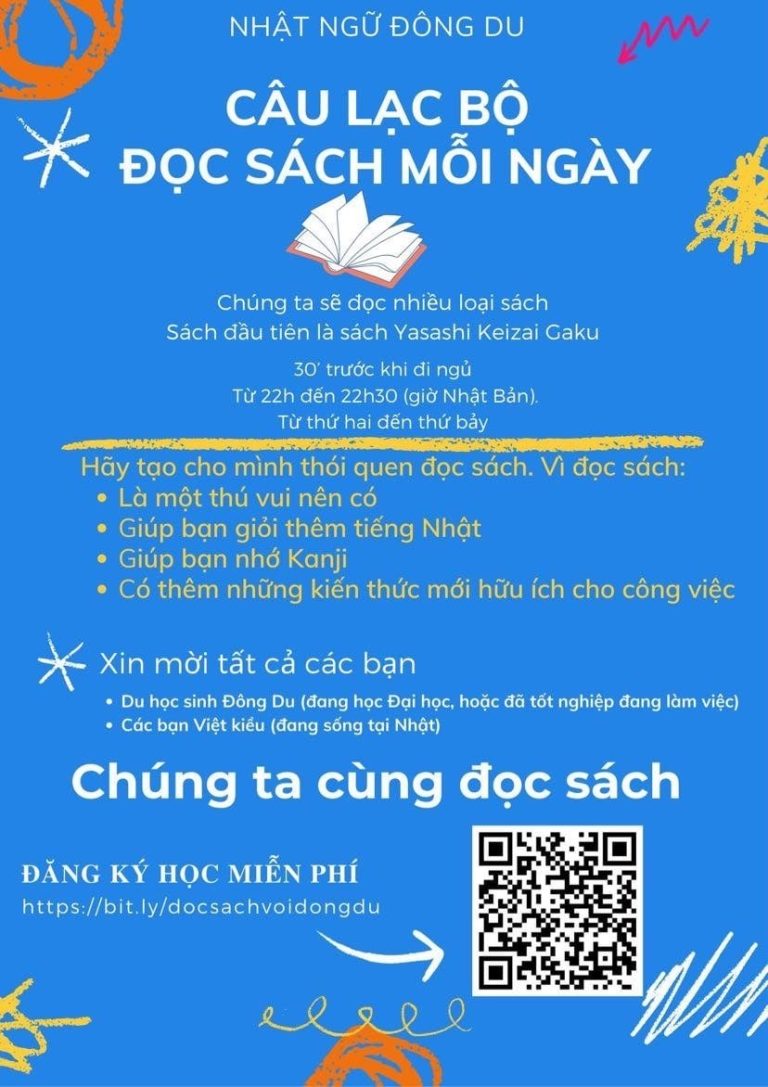
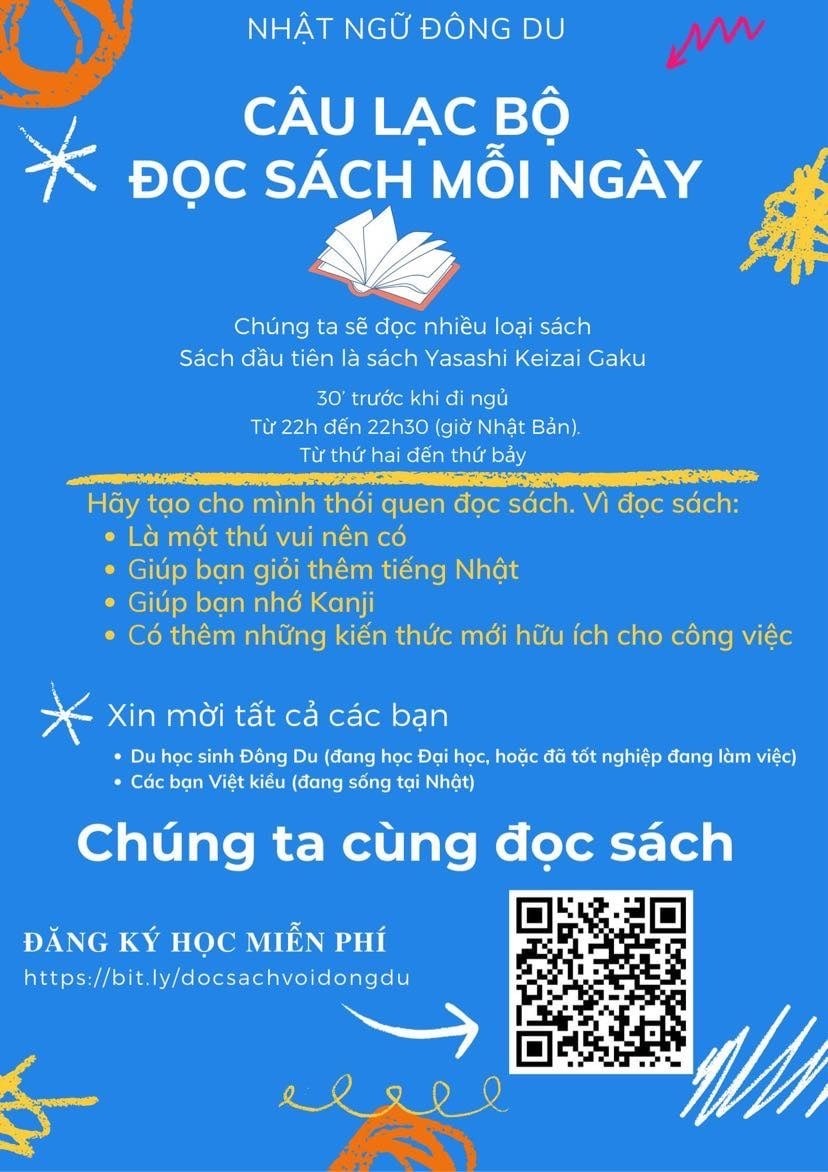
To help us build a daily reading habit and broaden our knowledge, the Dong Du Japanese-Language School has launched a Reading Club. From Monday to Saturday each week, you can spend 30 minutes online connecting to the club via the link below (see the attached poster):
In addition, the Vietnamese Association in Japan will publish its newsletter once every three months from September 2021, sharing essays, commentary, and information that help us better understand the Vietnamese community in Japan and the Japanese people and nation — and that strengthen the friendship between our two peoples.